
Anyone who’s lived in southern Arizona for a while knows the region boasts a far greater diversity in flora and fauna than out-of-staters might expect. We even occasionally make the national news—such as when a rare jaguar or ocelot sighting occurs.
Mild winters and somewhat cooler summer temperatures relative to the Phoenix area make the region enveloping Tucson and Green Valley a haven for many types of wildlife. It’s no wonder local residents enjoy exploring outdoor attractions and trails near Green Valley to discover what they might spot. Learning how to identify animal tracks adds to the adventure.
An Endangered River Provides Crucial Habitat
Named the fourth most endangered river in the U.S. by American Rivers in 2024, the Santa Cruz River is approximately 184 miles long. It starts in the San Rafael Valley and runs south into Mexico, where it takes a U-turn and then runs north through Green Valley to Marana.
Portions of the river, including the segment running through Green Valley, are dry riverbed much of the year. But snowmelt from the mountains and occasional heavy rains, like those occurring during monsoon season, can produce flowing water in the riverbed.
In the Tucson area, the release of up to 2.8 million gallons of treated wastewater daily through the Santa Cruz River Heritage Project has renewed perennial flow in about a one-mile stretch of the river. Similar efforts have restored perennial flow in other stretches of the river.
Water in the riverbed, even where it’s only temporary, attracts a variety of wildlife, including birds and other species that may be migrating through the region. Hence, areas adjacent to the river can be fertile ground if you’re interested in searching for wildlife tracks.
Looking for more ways to explore the area?
Discover nearby trails, nature destinations and things to do around Green Valley.
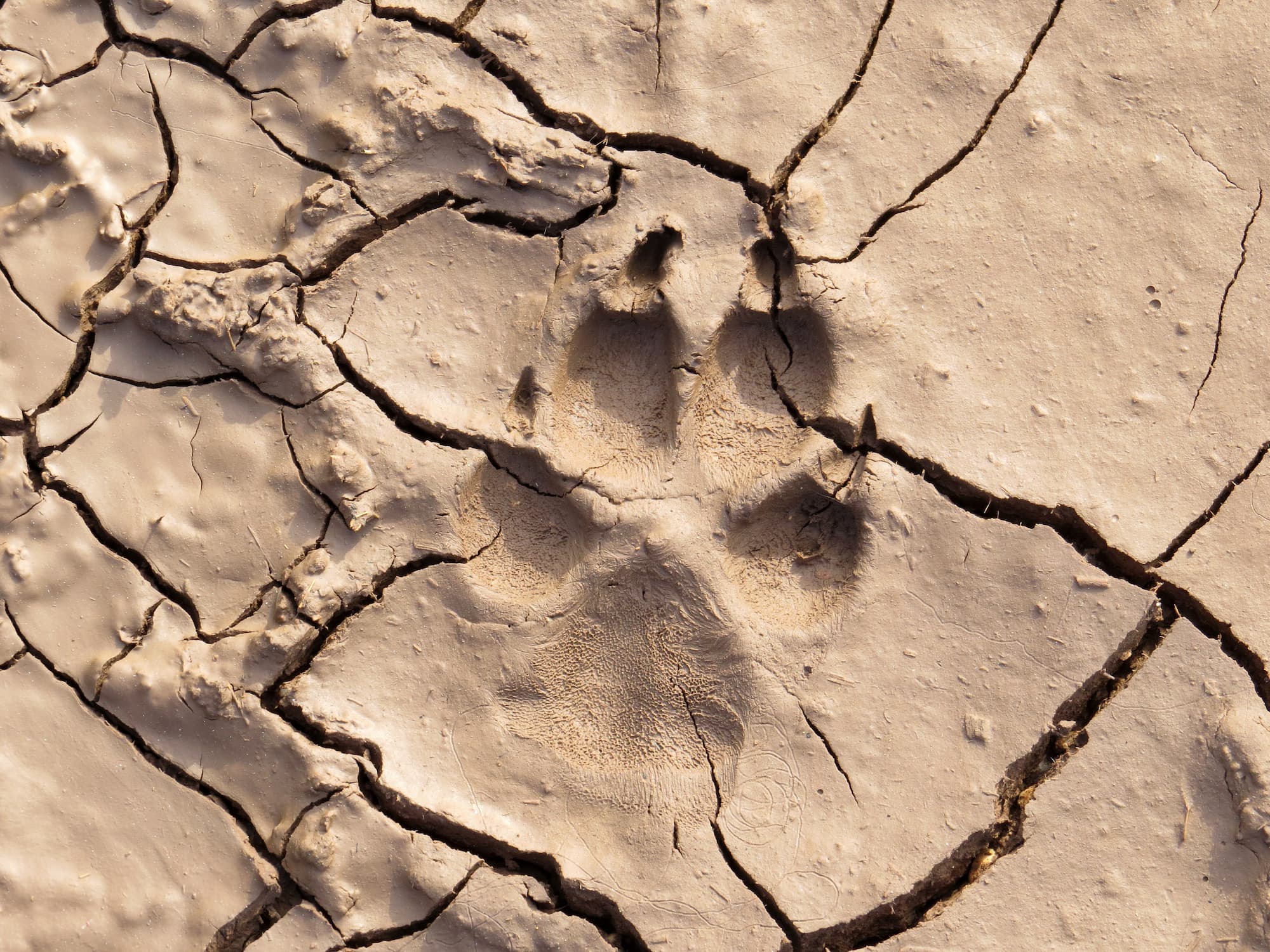
Common Southern Arizona Animal Tracks
While tracks left by coyotes, javelinas and rabbits are among the most commonly spied wildlife tracks, you might also come across deer, roadrunner and tortoise tracks. Since many species are nocturnal, it’s a good idea to venture out early in the morning if you hope to find fresh tracks.
Walking local trails and spending time in nature can also support an active senior wellness lifestyle.
Badgers
Although you’re unlikely to see a badger during the day, you might encounter one at dusk or dawn, especially if you’re out hiking with your dog. Badger tracks for both front and back feet have five crescent-shaped toes arranged in an arc. Claw marks are considerably longer on the front feet than on the hind feet. The pad behind the toes is wide and shaped like a kidney. Including the claw marks, badger tracks typically measure from 2 to 3.5 inches in length and width.
Bobcats
Bobcat tracks have a round shape overall, with four toes and a large heel pad that has three lobes—similar to the paw print of a housecat. Like most other wild cats, bobcats keep their claws retracted when walking, so you typically won’t see claw marks. The negative space between the toes and the heel pad forms a “C.” An adult bobcat’s track measures about 2 inches in diameter.
Coatimundis
Coatimundi tracks feature five cigar-shaped toes, with the three middle toes close together, and long, sharp claw marks, particularly on the front paws. These relatives of raccoons have a C-shaped negative space between the toes and the heel pad, and front tracks will show an extra heel pad at the rear. Coatis walk flat-footed on their hind feet. Tracks measure 1.5 to 3.5 inches in length and about 1.6 inches wide.
Coyotes
The overall shape of a coyote track is oval, measuring roughly 2.5 inches long and 2 inches wide. Both front and hind feet have four toes and claw marks. A slight lead toe may be noticeable. The inner two toes are smaller than the outer two. Heel pads are shaped like a triangle, with pads in the hind tracks being a little smaller than those in front.
Deer (White-Tailed and Mule)
Both types of deer leave a print with two predominant hoof toes, or cleaves, that form an inverted heart—unless the deer is moving fast or is on soft terrain, in which case the toes are splayed in front. In some instances, two smaller dots caused by dewclaws may be visible behind the hoof toe prints. Mule deer tracks are between 2.5 and 3.5 inches long. White-tailed deer tracks are typically 1.5 to 3 inches long.
Foxes (Gray, Kit and Red)
Fox tracks are oval-shaped, with four toes and (usually) claw marks at the tips, triangular, diamond- or chevron-shaped heel pads and X- or H-shaped negative spaces between the toes and pads. Gray fox tracks measure about 1.25 to 1.75 inches in length and 1 to 1.75 inches in width. Kit fox tracks typically measure 1.2 to 1.5 inches. Red fox tracks are between 1.75 to 2.5 inches long and 1.5 to 2 inches wide. Foxes, particularly red and kit foxes, have furrier feet than coyotes, so claw marks and toe prints may not be as visible. Gray foxes can retract their claws.
Gila Monsters
The tracks of Gila monsters have five long clawed toe marks and measure approximately 1 inch in width. A prominent, continuous drag mark from their tails runs through the center of left and right foot tracks. Do not approach or pick up these reptiles, as they are venomous.
Rattlesnakes
Rattlesnakes are venomous pit vipers known for their distinctive wide triangular head, a rattle made of keratin segments on the tip of the tail, and diamonds, bands or blotches on their skin that helps to camouflage them. They are not generally aggressive but if startled or approached, will act defensively and strike. Rattlesnakes leave tracks in sand and soft dirt which can include a series of unconnected diagonal lines or “half-moons” if left by a sidewinder. Or they can leave straight “caterpillar” tracks since many move in relatively straight lines.
Javelinas
Javelina tracks are similar to deer tracks, though about half the size and less pointed. They typically travel in herds and while they have poor eyesight, they have tusk-like teeth that can inflict serious wounds.
Mountain Lions
The tracks of a mountain lion are similar to, but smaller than, those of a jaguar, measuring about 2.75 to 3.75 inches in diameter. While generally round, mountain lion tracks have a differentiating feature: a leading toe that gives each print a slightly asymmetrical shape. If you see a mountain lion, it is recommended to not run but stand tall, wave your arms and yell.
Black Bears
Black bear tracks and sightings have increased in the Tucson and Oro Valley areas, particularly around the Catalina Foothills, Mt. Lemmon and Sabino Canyon. Drought conditions often drive these animals down from the surrounding mountains in search of food, often in residential areas. They have large, flat-footed prints with five toes and a wide, kidney-shaped heel pad, often resembling a small, broad human footprint. They measure 3 to 6 inches wide. Do not approach these bears and secure garbage and all food sources to prevent interactions.
Cottontail Rabbits
A set of four tracks from a rabbit often form a Y-shaped or rectangular pattern in mud or soft ground, with the two elongated hind prints positioned in front of the two smaller front prints. This results from the rabbit’s bounding gait. Hind prints can be 3 to 4 inches long. Front prints are shorter. Fur typically prevents individual toe prints from forming in the tracks.
Raccoons
The front paw prints of raccoons are roughly 2 inches wide. They resemble small, slender human hand prints, with five toes and C-shaped palm prints. Hind paw prints, which have an overall length of about 4 inches, feature five long toe prints and V-shaped heel prints. Claw marks may or may not be visible.
Roadrunners
These desert dwellers leave easy-to-recognize X-shaped tracks, as they have two toes pointing forward and two pointing backward. The usual length is 2 to 3 inches. Because the tracks are symmetrical, it can be difficult to tell which way the bird was traveling!
Scorpions
Scorpion tracks are narrow (generally less than an inch), with two parallel rows of dotted footprints and frequently a thin drag mark in the center from the tail. These venomous arachnids are typically nocturnal hunters and glow under UV light because of fluorescent compounds in their exoskeletons.
Skunks
Skunk tracks often look like cat tracks except they have five toes instead of four and visible claw marks from the skunk’s long, unretractable nails. They measure about 1.5 to 2.5 inches in length, with the skunk’s rear paws sometimes leaving long, rectangular heel prints.
Sonoran Desert Tortoises
Tortoises leave two parallel rows of stumpy depressions, about 1 inch wide, that may resemble tiny elephant footprints with claw marks at the tips of the toes. A faint line may appear between the rows from dragging the tail.
A Shoutout to the Wild Cat Center at the University of Arizona
The university’s Wild Cat Research and Conservation Center is a nonprofit organization engaged in research and wildlife monitoring, with the primary goal of promoting wild cat conservation all over the world. Local residents can participate in the center’s Citizen Science initiative, working with experts to learn about camera monitoring, tracking, eDNA sampling and data analyses.
As noted earlier, rare sightings of jaguars and ocelots have occurred in southern Arizona. Here’s how to tell their tracks apart from tracks made by other wild cats:
Jaguars – Jaguar tracks are round, typically about 4 inches long and 4.8 inches wide. Four rounded toes on each foot are separated only slightly from a rounded, three-lobed (or M-shaped) heel pad.
Ocelots – Ocelot tracks look like a smaller version of mountain lion tracks, including the leading toe. They measure about 2 inches in width (similar to the size of a bobcat track) and are slightly wider than they are long. Heel pads have a rounded “M” appearance.
More Wild Animal Identification Methods
Tracks are not the only way to identify animals in their natural habitat. Wildlife signs such as scat, fur, feathers and scratch marks on tree bark can also be useful.
Want a handy visual aid to take when you explore the outdoors? A variety of apps are available to download on your phone.
Or take an animal tracks identification guide. Here are two suggestions. Both are PDFs and can be downloaded:
- The Southwest Arizona Track and Scat Glovebox Guide published by The University of Arizona Cooperative Extension
- A handy checklist created by the Santa Cruz Museum of Natural History, which includes photos and illustrations of various wildlife tracks and scat
Residents can also continue exploring the region through La Posada’s Hiking Club and off-campus excursions.
Are you interested in exploring southern Arizona’s trails and learning more about the abundant wildlife in our area? Choosing independent living in Green Valley, you’d have easy access and plenty of opportunities. Give us a call at 520-329-5592 to schedule a visit of our nationally recognized senior living community.
Stay active and connected in Green Valley
Explore an Independent Living community where outdoor recreation, resident outings and Southern Arizona’s natural beauty are close at hand.
Featured Image: Charles T. Peden, Snap Happy and Dan Shachar / Shutterstock